
Water Damaged Floors: What Survives and What Comes Out
Hardwood is often saveable and laminate almost never is. The difference is how each material is built.

Flooring is usually the most expensive thing in a water loss and the decision people get wrong most often. Hardwood that looks ruined can frequently be saved. Laminate that looks fine almost never can.
The difference is not how bad it looks a day after the leak — it is how the material is built, and whether anyone started pulling water out of it quickly enough.
Solid hardwood: usually worth trying to save
Solid timber absorbs water slowly and releases it slowly, which is exactly why it is salvageable. Boards cup as the underside takes on moisture faster than the sealed top, and that cupping is alarming to look at and frequently reversible. Many floors that look destroyed at 48 hours flatten substantially once the moisture is pulled back out and the board equalises.
The method is mat drying: impermeable mats sealed to the floor surface, connected to a vacuum unit that pulls moisture up through the boards rather than waiting for it to evaporate on its own. It typically runs five to ten days with daily readings, and it is slower and more expensive per day than replacement equipment — but far cheaper than a new floor that will not match the rest of the house.
What ends it: boards that have crowned rather than cupped after drying, sustained high readings in the subfloor, or any sign the adhesive and subfloor beneath have failed.
Engineered wood: it depends on the wear layer
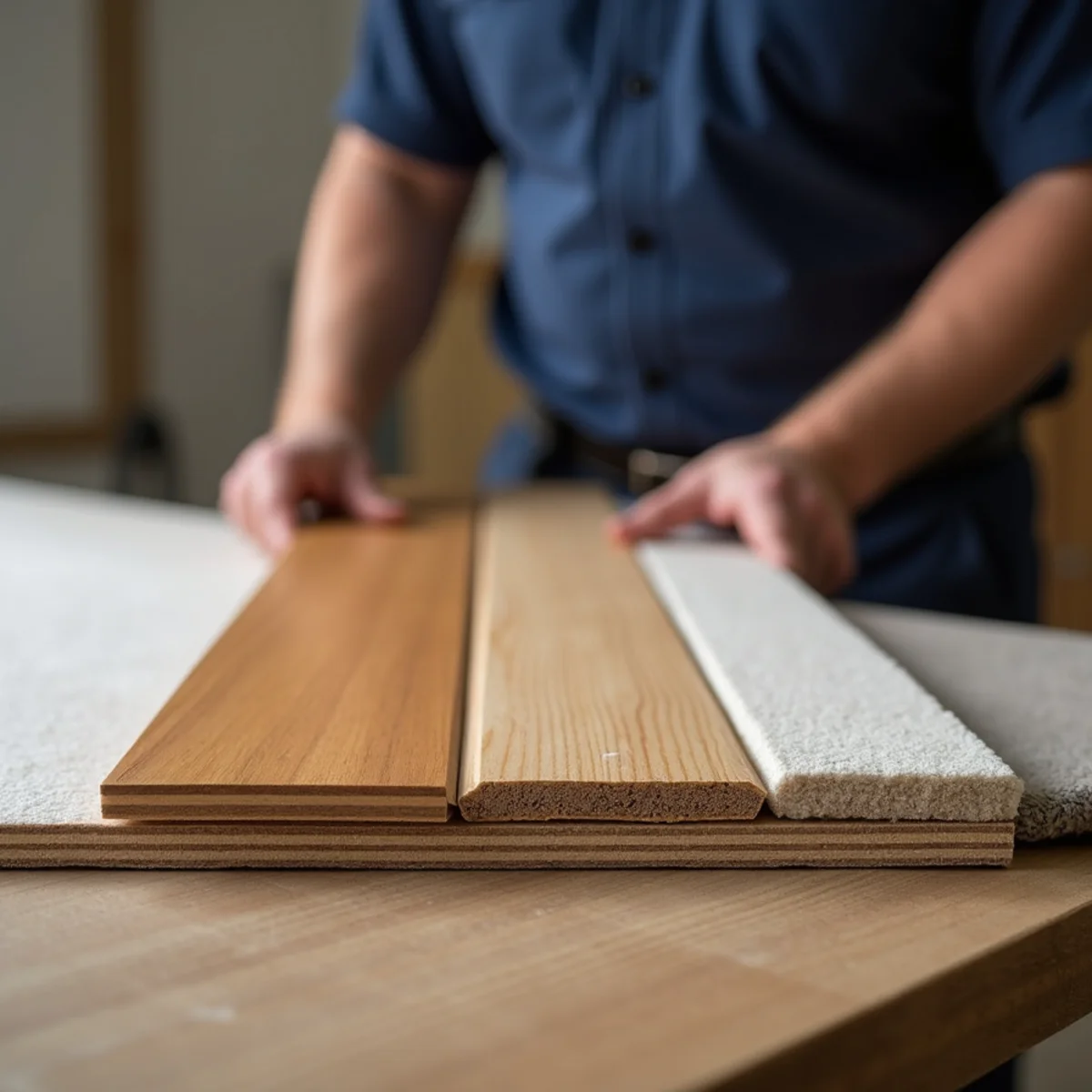
Engineered boards are a thin hardwood veneer over a plywood or fibreboard core. They are more dimensionally stable than solid timber while dry, and less forgiving once wet, because the failure mode is delamination — the veneer separating from the core — and delamination is not reversible.
Caught early, engineered floors can be mat-dried like solid timber and often recover. Once you can see the layers lifting at a board edge or the surface has bubbled, the board is finished. A thicker wear layer buys more time; a paper-thin veneer buys almost none.
Laminate: almost always replaced
Laminate is a photographic layer over a high-density fibreboard core. The core is essentially compressed paper, and when it takes on water it swells irreversibly — it does not shrink back when dried. Swelling at the board edges, a chalky feel, or any lifting at the seams means the plank is done.
This is the one category where we will usually tell you not to spend money on drying the flooring itself. The useful work is drying the subfloor and the structure beneath it properly, so the replacement goes down onto something dry rather than trapping moisture under a brand-new floor.
Carpet and pad: two separate decisions
Carpet and its pad are almost always treated differently, which surprises people. The pad is a sponge, it is inexpensive, and it is nearly always replaced. The carpet itself can often be saved after clean-water damage if it is extracted promptly and dried properly, including floating it to push air underneath.
Contamination changes everything. Carpet touched by Category 3 water — sewage, drain backup, or water that has been over the ground — comes out regardless of condition, because contaminants penetrate the full thickness of a porous material and cannot be reliably disinfected in place.
Tile and stone: the floor is fine, the question is underneath
Ceramic, porcelain and most stone are effectively unaffected by water. The tile is rarely the problem. What matters is whether water got beneath it — through grout lines, at the perimeter, or through a failed slab penetration — and is now sitting against the subfloor or substrate with nowhere to evaporate.
Trapped moisture under tile presents as a hollow sound when tapped, loose or lifting tiles, persistent grout discolouration, or a musty smell with a floor that reads dry on top. Diagnosing it usually means lifting a tile in an inconspicuous spot, which is a small intervention compared with discovering the problem a year later.
What actually decides the outcome
- How fast extraction started. Every hour of standing water pushes more material across the line.
- Water category. Clean water allows salvage decisions; contaminated water removes most of them.
- Whether the subfloor was dried. A saved surface over a wet subfloor fails later and takes the new work with it.
- Whether anyone metered it. Floors are declared dry by appearance far too often; appearance is not a reading.
- Whether the material is replaceable at all. A discontinued floor changes the maths entirely — specialty drying is worth far more when a match does not exist.
Frequently asked
How long does it take hardwood floors to dry after water damage?
Mat drying a hardwood floor typically runs five to ten days, which is considerably longer than the three to five days a structure usually needs. Timber releases moisture slowly and forcing it faster causes checking and splitting. It is finished when readings match an unaffected area of the same floor in the same house — not on a scheduled day.
Will cupped hardwood flatten out on its own?
Sometimes, partially, over months — and often not completely. Controlled drying gives a far better result than waiting, because it pulls moisture from the underside where it is trapped rather than relying on slow evaporation through a sealed surface. If a floor has crowned instead, meaning the board edges are now lower than the centre, that usually indicates it was sanded while still wet and the damage is permanent.
Can water damaged laminate flooring be dried out?
Realistically, no. The fibreboard core swells irreversibly once it takes on water and does not return to size when dried. If the planks have swollen at the edges or lifted at the seams, replacement is the honest answer. Spend the drying budget on the subfloor underneath instead, so the new flooring is not laid over trapped moisture.
How much does water damaged floor repair cost?
It varies too much with area and material for a single figure to be useful, but the comparison worth running is specialty drying against replacement. Mat drying a hardwood floor for several extra days commonly costs a fraction of replacing it — and avoids a new floor that does not match the adjoining rooms. Where the floor is discontinued or runs continuously through the house, that calculation moves strongly toward drying.
The bottom line
The single biggest determinant of whether your floor survives is how quickly somebody started pulling water out of it. Nearly every floor we have failed to save was one where drying began days late, not one where the leak was unusually large.
If your floor is wet now, the useful call is today rather than after the weekend — and we will tell you honestly when a floor is past saving rather than running equipment on it for a week.